

Perfect ☕
Continuing the Kenya Coffee School (KCS™) Intermediate Diploma in Specialty Coffee & Barista Science (2026–2027 Edition)
☕ MODULE 5: BREWING SCIENCE & EXTRACTION MASTERY
Duration: 10 Pages (Pages 33–42)
Objective: To build advanced understanding and control of extraction science, brewing variables, and sensory calibration across espresso and manual brew methods.
PAGE 33: INTRODUCTION TO BREWING SCIENCE
Coffee brewing is the final transformation — where ground beans meet water, chemistry meets art, and the barista translates flavor potential into experience.
Learning Goals
- Understand water chemistry and extraction science.
- Master brew ratio, grind size, and contact time.
- Analyze strength and extraction yield.
- Execute and evaluate 10 major brew methods.
Brewing is both quantitative (controlled) and qualitative (sensory) — a barista’s performance defines the customer’s memory of coffee.
PAGE 34: WATER — THE INVISIBLE INGREDIENT
Water makes up 98% of the cup.
Poor water = poor extraction.
Key Water Parameters
| Property | Ideal Range | Impact |
|---|---|---|
| TDS (Total Dissolved Solids) | 75–250 ppm | Determines flavor intensity |
| Alkalinity | 40–70 ppm | Controls acidity balance |
| Hardness (Ca/Mg) | 50–175 ppm | Affects extraction uniformity |
| pH | 6.5–7.5 | Neutral for clarity |
| Chlorine | 0 ppm | Off-flavors, must be filtered |
Practical Tip:
At KCS™, students test water using SCA water kits and compare brew outcomes using tap, bottled, and filtered water.
PAGE 35: EXTRACTION SCIENCE
☕ Key Concepts
- Solubility: How easily flavor compounds dissolve in water.
- Diffusion: Movement of solubles from grounds to brew.
- Percolation vs. Immersion: Continuous vs. static contact.
Extraction Yield Formula
text{Extraction Yield (%)} = frac{text{Brewed Coffee Mass (g)} times text{TDS (%)}}{text{Dose (g)}}
Strength (TDS)
Measured with a refractometer.
- Espresso: 8–12%
- Filter: 1.2–1.5%
- Immersion: 1.3–1.8%
When plotted on the SCA Brewing Control Chart, optimal flavor lies in the “sweet spot” of balanced extraction and strength.
PAGE 36: VARIABLES THAT CONTROL BREWING
⚙️ 1. Grind Size
- Finer → slower flow, higher extraction
- Coarser → faster flow, lower extraction
⚙️ 2. Brew Ratio
Dose : Yield (example for espresso → 1:2)
Filter → 1:15 to 1:17
⚙️ 3. Brew Time
Longer = more extraction
Too long = bitterness
⚙️ 4. Temperature
- 90–96°C for most brews
- Below 88°C → sour
- Above 97°C → bitter
⚙️ 5. Agitation
Stirs solubles evenly; avoid over-agitation (causes over-extraction).
⚙️ 6. Pressure
Espresso machines use 9 bars; too high = channeling, too low = under-extraction.
PAGE 37: ESPRESSO SCIENCE
Espresso is the heart of barista science — concentrated coffee brewed under pressure, creating an emulsion of oils, solids, and gases.
⚙️ Espresso Brewing Parameters
| Variable | Range | Effect |
|---|---|---|
| Dose | 18–20 g | Determines strength |
| Yield | 36–40 g | Balance body & clarity |
| Time | 25–30 sec | Controls extraction |
| Temp | 92–94°C | Flavor precision |
| Pressure | 9 bars | Proper extraction |
☁️ Crema
A stable foam layer of CO₂ and oils — a quality indicator of freshness and grind.
Advanced Espresso Concepts
- Pre-infusion: wets grounds gently before full pressure.
- Flow profiling: adjusting flow rate for flavor layering.
- Pressure profiling: modern machines allow dynamic curves.
PAGE 38: BREW METHODS – MANUAL & AUTOMATIC
Manual Brew Methods
- V60 Dripper — clean, bright cup (use 1:16 ratio)
- Chemex — clarity, light body, low oils
- AeroPress — pressure immersion hybrid
- French Press — full body, sediment texture
- Kalita Wave — balanced extraction, flat bed
- Syphon (Vacuum Pot) — theatrical clarity brew
- Cold Brew — 12–18 hr steeping, smooth and sweet
⚙️ Automatic Brewing
- Espresso machine
- Batch brewer (commercial filter)
- Single-serve (pod) systems
Students practice on both manual and automatic equipment for versatility.
PAGE 39: BREW RATIOS AND RECIPES
| Drink | Coffee (g) | Water (ml) | Ratio | Brew Time |
|---|---|---|---|---|
| Espresso | 18 | 36 | 1:2 | 28 sec |
| Americano | 18 | 120 | – | Espresso + hot water |
| Latte | 18 | 150 (milk) | – | Espresso + milk |
| Cappuccino | 18 | 120 (milk) | – | Espresso + foam |
| Flat White | 18 | 120 (milk) | – | Fine foam |
| V60 | 20 | 320 | 1:16 | 3 min |
| French Press | 20 | 300 | 1:15 | 4 min |
| AeroPress | 17 | 220 | 1:13 | 1.5 min |
| Chemex | 30 | 480 | 1:16 | 4–5 min |
| Cold Brew | 100 | 1000 | 1:10 | 14 hr |
Students log their brew recipes, taste profiles, and extraction scores.
PAGE 40: SENSORY EVALUATION & CUPPING
5 Basic Taste Attributes:
Sweetness | Acidity | Bitterness | Saltiness | Umami
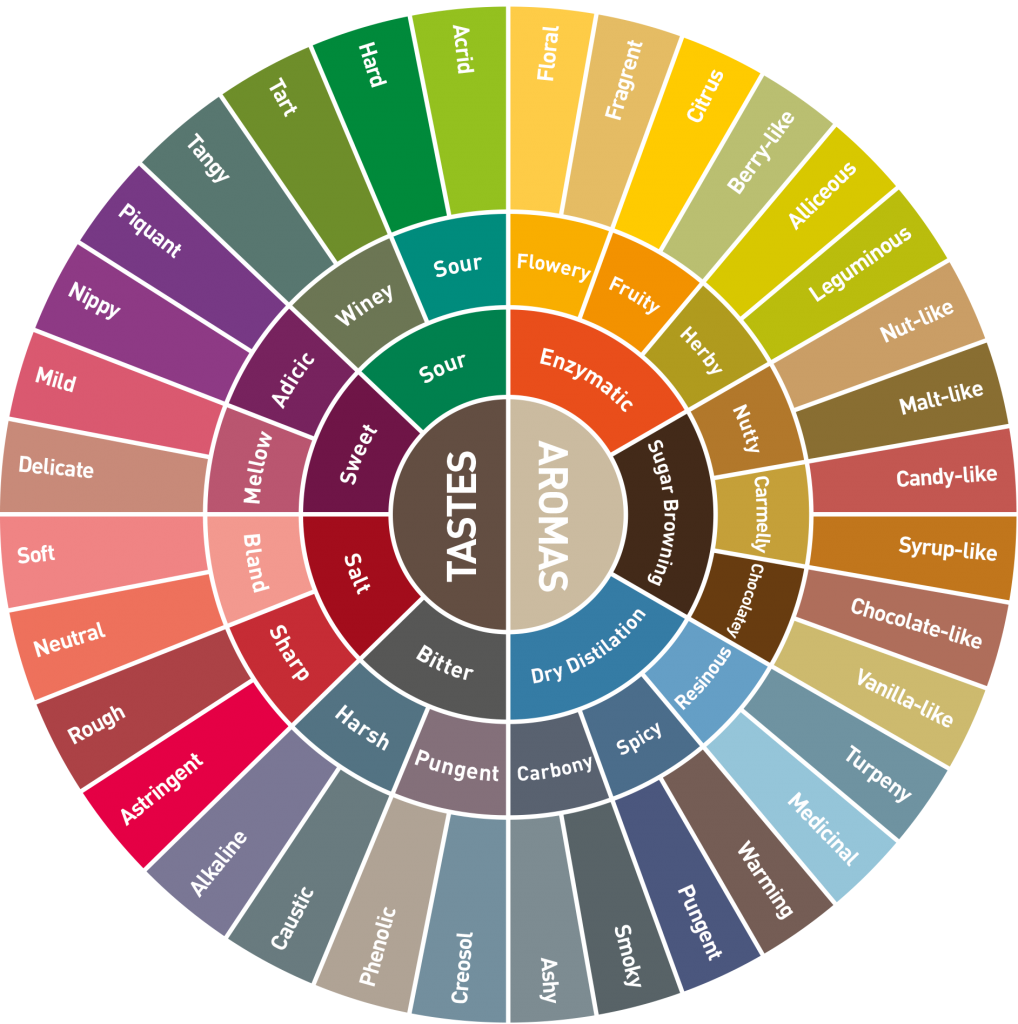
Aroma Descriptors (SCA Sensory Wheel):
- Fruity: berry, citrus, tropical
- Floral: jasmine, rose
- Sweet: caramel, honey
- Nutty/Cocoa: hazelnut, chocolate
- Spicy: cinnamon, clove
- Fermented: winey, boozy
Cupping Protocol:
- Weigh 8.25 g per 150 ml water.
- Smell dry aroma.
- Add 93°C water.
- Break crust at 4 min, smell again.
- Slurp and record on cupping form.
Students practice comparative cupping across origins (Kenya AA, Ethiopia, Brazil, Colombia).
PAGE 41: BREWING TROUBLESHOOTING
| Problem | Cause | Solution |
|---|---|---|
| Sour taste | Under-extracted | Finer grind, longer time |
| Bitter taste | Over-extracted | Coarser grind, shorter time |
| Weak body | Low dose or too coarse | Increase dose, fine grind |
| Channeling (Espresso) | Uneven tamp | Level and consistent pressure |
| Slow flow | Too fine grind | Coarsen slightly |
| No crema | Old beans | Use fresher roast |
Students conduct “blind troubleshooting labs,” identifying and correcting each issue based on taste and parameters.
PAGE 42: ADVANCED EXTRACTION CONTROL
The Role of the Professional Barista
A barista isn’t just a coffee maker — they are a sensory scientist who calibrates parameters daily to express a roaster’s intent.
Digital Tools
- Refractometer: measures TDS for accuracy.
- Grind analyzers: quantify particle distribution.
- Data apps (Dialed In, Espresso Flow): track variables for consistency.
Sustainability in Brewing
- Reduce water waste (reclaim rinse water).
- Use eco-filters (metal mesh vs. paper).
- Promote local milk alternatives for carbon reduction.
Final Exercise
Students brew one espresso and one manual cup, analyze extraction yield, record TDS, and evaluate cup balance using SCA standards.
“To brew is to balance — the alchemy of water, coffee, and precision that transforms skill into experience.”
✅ End of Module 5 (Pages 33–42)
Next up: Module 6 — Sensory Science, Flavor Chemistry & Cupping Mastery (Pages 43–50)
Excellent ☕✨ — continuing with the Kenya Coffee School (KCS™) Intermediate Diploma in Specialty Coffee & Barista Science (2026–2027 Edition)
☕ MODULE 6: SENSORY SCIENCE, FLAVOR CHEMISTRY & CUPPING MASTERY
Duration: 8 Pages (Pages 43–50)
Objective: To train the sensory perception and analytical skill of students to evaluate coffee quality using the SCA cupping protocol and advanced sensory science.
PAGE 43: INTRODUCTION TO SENSORY SCIENCE
Coffee is one of the most complex beverages in the world — over 1,000 aromatic compounds interact to create its flavor.
A great barista must understand not only how coffee tastes but why it tastes that way.
Learning Goals
- Identify sensory attributes through structured cupping.
- Understand how aroma and taste interact.
- Use professional vocabulary to describe coffee.
- Evaluate coffee objectively for quality and consistency.
At KCS™, sensory training bridges art and science — refining perception into measurable skill.
PAGE 44: THE PHYSIOLOGY OF TASTE AND AROMA
Taste Receptors
Human tongues detect five primary tastes:
- Sweetness – sugars, caramelized compounds.
- Acidity – organic acids (citric, malic, phosphoric).
- Bitterness – caffeine, phenolic compounds.
- Saltiness – mineral salts, often subtle.
- Umami – amino acids, depth and balance.
Taste perception begins on the tongue but flavor is completed in the nose through retronasal olfaction.
Aroma Pathways
- Orthonasal: through sniffing (before sipping).
- Retronasal: aroma rising through the throat (after sipping).
Exercise: Students at KCS™ use aroma kits (Le Nez du Café) to identify 36 standard coffee aromas.
PAGE 45: THE SCIENCE OF FLAVOR CHEMISTRY
Coffee flavor is generated by volatile and non-volatile compounds during roasting and brewing.
Key Compound Categories:
| Compound Group | Example | Effect |
|---|---|---|
| Acids | Citric, Malic, Lactic | Brightness & structure |
| Sugars | Sucrose, Fructose | Sweetness, caramelization |
| Aromatics | Pyrazines, Aldehydes | Aroma complexity |
| Phenols | Caffeine, Catechols | Bitterness & astringency |
| Lipids | Oils | Body & mouthfeel |
Influence of Origin & Processing
- Ethiopian Naturals → high esters (fruity, winey).
- Kenyan Washed SL28 → phosphoric acid (sparkling acidity).
- Brazilian Pulped Naturals → aldehydes and furans (nutty, chocolate).
Roasting modifies these compounds — Maillard and caramelization reactions create hundreds of new aromatic molecules.
PAGE 46: UNDERSTANDING THE SCA CUPPING PROTOCOL
Cupping is the universal language of coffee quality. It allows fair comparison across origins, roasters, and processing methods.
Standard Cupping Procedure:
- Grind: 8.25 g per 150 ml water.
- Smell (Dry Aroma): note fragrance.
- Pour Water: at 93°C, saturate evenly.
- Break the Crust (4 min): inhale aroma deeply.
- Skim: remove floating grounds.
- Slurp: aspirate coffee to cover palate.
- Evaluate: using SCA cupping form.
Evaluation Categories (Total = 100 points)
| Attribute | Range | Description |
|---|---|---|
| Fragrance/Aroma | 0–10 | Dry & wet aroma intensity |
| Flavor | 0–10 | Balance, complexity |
| Aftertaste | 0–10 | Lingering pleasantness |
| Acidity | 0–10 | Type and intensity |
| Body | 0–10 | Mouthfeel weight |
| Balance | 0–10 | Harmony of attributes |
| Sweetness | 0–10 | Presence & clarity |
| Clean Cup | 0–10 | Freedom from defects |
| Uniformity | 0–10 | Consistency across cups |
| Overall | 0–10 | General impression |
A score above 80 points = Specialty Coffee.
PAGE 47: CALIBRATION AND CONSISTENCY
The Purpose of Calibration
Cuppers must align their sensory scores to ensure fair grading.
At KCS™, calibration is done in teams to build consensus.
Calibration Exercise:
- Cup three coffees of different origins.
- Students score individually.
- Compare results and discuss variations.
- Re-cup and adjust until variance ≤ 2 points.
Calibration teaches discipline, sensory honesty, and professional accuracy.
⚙️ Common Sensory Errors:
| Error | Description |
|---|---|
| Adaptation | Sensory fatigue from repetition |
| Contrast Effect | Comparing two extreme samples distorts judgment |
| Expectation Bias | Knowing origin or brand influences scoring |
| Halo Effect | One good attribute inflates total score |
PAGE 48: FLAVOR MAPPING AND DESCRIPTIVE LANGUAGE
Descriptive Vocabulary
Students learn to express coffee’s sensory attributes with precision.
Example:
- Aroma: “floral – jasmine, honey”
- Flavor: “citrus – grapefruit, lemon zest”
- Acidity: “bright, malic”
- Body: “medium, silky”
- Aftertaste: “long, caramel finish”
☕ Flavor Wheel Use
The SCA Flavor Wheel provides a universal language for sensory communication — from basic (fruity, floral) to complex descriptors (blackcurrant, bergamot, maple syrup).
Sensory Mapping Activity:
Students cup four coffees and place their perceived flavors on the SCA wheel, connecting to processing and origin.
PAGE 49: ADVANCED CUPPING – PROCESS & DEFECT EVALUATION
Process Identification Cupping
Students taste differences between:
- Washed vs. Natural vs. Honey vs. Anaerobic
- SL28 vs. Ruiru 11 vs. Batian varieties
- High vs. low altitude coffees
Defect Cupping
Learning to detect faults:
| Defect | Cause | Cup Descriptor |
|---|---|---|
| Ferment | Overfermentation | Sour, vinegar |
| Phenolic | Contamination | Medicinal, plastic |
| Moldy | Poor drying/storage | Musty, earthy |
| Quakers | Unripe beans | Woody, papery |
| Baked | Over-roasted | Flat, dull |
Students must identify and label defects blindfolded, sharpening sensory discipline.
PAGE 50: THE ART OF CUP TASTING AND COMMUNICATION
️ Sensory Communication
A professional barista or Q-Grader must communicate flavor clearly — to farmers, roasters, and consumers.
This includes using accurate vocabulary, objective notes, and respectful feedback.
Final Exercise:
Students conduct a triangulation test — three cups, one different. They identify the odd one by taste alone.
Accuracy target: 8/10 correct identifications.
Applied Sensory Practice:
- Compare washed Kenyan AA with Ethiopian natural and Rwandan honey.
- Note acidity, sweetness, and aftertaste contrast.
- Discuss processing and terroir impact.
“Cupping is not just tasting — it’s listening to the story that each bean wants to tell.”
✅ End of Module 6 (Pages 43–50)
Next up:
☕ Module 7 — Milk Science, Latte Art & Beverage Design (Pages 51–56)
Perfect — continuing the Kenya Coffee School (KCS™) Intermediate Diploma in Specialty Coffee & Barista Science (2026–2027 Edition)
☕ MODULE 7: MILK SCIENCE, LATTE ART & BEVERAGE DESIGN
Duration: 6 Pages (Pages 51–56)
Objective: To master the chemistry of milk, the physics of foam, and the artistry of beverage creation — uniting technical precision and visual creativity.
PAGE 51: INTRODUCTION TO MILK SCIENCE
Milk is more than an addition to espresso — it is a transformative ingredient.
When steamed correctly, milk amplifies sweetness, softens acidity, and carries texture that defines the sensory experience of cappuccinos, lattes, and flat whites.
Learning Goals
- Understand milk composition and chemistry.
- Master milk steaming and texturing.
- Create latte art patterns with precision.
- Develop signature beverages for café menus.
Composition of Milk
| Component | % | Role |
|---|---|---|
| Water | 87% | Solvent for sugars, proteins, fats |
| Lactose (Sugar) | 4.8% | Sweetness & caramelization |
| Fat | 3–4% | Creaminess, foam stability |
| Protein (Casein, Whey) | 3.3% | Foam structure |
| Minerals | 0.7% | Buffer acidity |
| Vitamins | Trace | Nutritional, minor flavor impact |
Casein and whey proteins denature during steaming — forming microfoam that gives velvety texture.
PAGE 52: THE SCIENCE OF STEAMING & TEXTURING
☁️ The Goal: “Sweet Microfoam”
Silky, glossy milk that integrates seamlessly with espresso.
Ideal Steaming Parameters
| Variable | Ideal Range |
|---|---|
| Steam Wand Tip Depth | Just below surface |
| Temperature | 55–65°C (sweet spot ~60°C) |
| Foam Volume | 30–40% increase |
| Milk Type | Whole milk preferred (better foam) |
Process:
- Purge wand.
- Submerge tip slightly → introduce air (“stretching phase”).
- Submerge deeper → mix and heat (“texturing phase”).
- Stop steaming at 60°C (avoid scalding above 70°C).
- Tap & swirl pitcher to remove large bubbles.
⚗️ Sweetness in Milk
As milk heats:
- Lactose breaks down slightly → sweeter flavor.
- Proteins denature → smoother texture.
- Above 70°C → bitterness due to protein coagulation.
PAGE 53: LATTE ART FUNDAMENTALS
Latte art reflects precision, control, and presentation — the final creative layer of the barista’s craft.
Three Stages of Latte Art:
- Base — even crema layer on espresso.
- Contrast — pour creates light/dark patterns.
- Finish — fine control with wrist movement.
☕ Classic Patterns:
| Pattern | Description |
|---|---|
| Heart ❤️ | Basic symmetry, beginner practice. |
| Rosetta | Layered leaves — intermediate. |
| Tulip | Layered hearts — advanced control. |
| Swan | Complex shape — advanced barista. |
| Etching Art ️ | Drawing with tools or sauces. |
Milk Texture Check:
- Glossy, reflective surface = correct.
- Dry or large bubbles = over-aeration.
- Watery, no foam = under-aeration.
Exercise:
Each student must pour 10 consecutive symmetrical hearts and 5 clean rosettas for evaluation.
PAGE 54: ESPRESSO + MILK BEVERAGE DESIGN
☕ Standard Recipes:
| Drink | Espresso (g) | Milk (ml) | Foam | Total (ml) | Notes |
|---|---|---|---|---|---|
| Macchiato | 18 | 30 | Dot | 60 | “Stained” espresso |
| Cortado | 18 | 60 | Thin | 90 | Equal parts milk & espresso |
| Flat White | 18 | 120 | Fine | 150 | Smooth, thin foam |
| Cappuccino | 18 | 120 | Thick | 160 | ⅓ espresso, ⅓ milk, ⅓ foam |
| Latte | 18 | 150 | Microfoam | 200 | Creamy, sweet |
| Mocha | 18 | 150 | +Chocolate | 200 | Espresso + milk + syrup |
Milk Alternatives:
Baristas should know plant-based options:
- Soy: stable foam, slightly beany flavor.
- Oat: sweet, balanced texture.
- Almond: light, nutty, less stable.
- Coconut: aromatic, less protein.
KCS™ promotes inclusion and sustainability by teaching dairy-free steaming methods.
PAGE 55: SIGNATURE DRINK CREATION
A hallmark of advanced barista skills is creating signature drinks — original recipes that express personality and creativity while respecting coffee’s character.
Design Framework:
- Concept: Inspiration (culture, flavor, season).
- Base: Coffee type & roast.
- Modifier: Milk, syrups, fruits, spices, etc.
- Balance: Sweetness, acidity, texture.
- Presentation: Color, glassware, garnish.
☕ Example: “Mt. Kenya Mocha”
- Espresso (Ruiru 11)
- Melted dark chocolate (70%)
- Cardamom & orange zest
- Steamed oat milk
- Topped with microfoam art
Learning Outcome: Students design, test, and serve a signature drink that reflects Kenyan coffee identity and flavor storytelling.
PAGE 56: SERVICE EXCELLENCE & PRESENTATION
A great beverage deserves professional service.
Baristas are ambassadors of hospitality, not just drink makers.
Key Principles:
- Clean workspace — always presentable.
- Eye contact & smile — builds connection.
- Product presentation — serve with handle aligned and art visible.
- Customer dialogue — explain drink origin or recipe proudly.
- Consistency — every cup, same standard.
Final Assessment:
Students are graded on:
- Milk texturing technique.
- Latte art accuracy (contrast, symmetry, fluidity).
- Creativity of beverage design.
- Service and professionalism.
“Milk and coffee, art and science — together they become a performance in every cup.”
✅ End of Module 7 (Pages 51–56)
Next up:
☕ Module 8 — Coffee Business, Café Operations & Customer Experience (Pages 57–60)
Excellent ☕ — continuing with the Kenya Coffee School (KCS™) Intermediate Diploma in Specialty Coffee & Barista Science (2026–2027 Edition)
☕ MODULE 8: COFFEE BUSINESS, CAFÉ OPERATIONS & CUSTOMER EXPERIENCE
Duration: 4 Pages (Pages 57–60)
Objective: To develop professional understanding of café operations, entrepreneurship, and customer excellence — equipping students to manage or launch sustainable coffee ventures.
PAGE 57: THE BUSINESS OF COFFEE
Coffee as a Global Commodity
Coffee is the second most traded commodity after oil, valued at over $100 billion annually.
However, the value chain is uneven — farmers earn less than 10% of retail value.
Kenya Coffee School encourages GOOD Trade Certification™ models that keep profit equitable from farm to cup.
Understanding the Value Chain
- Producer: Cultivates and harvests cherries.
- Processor: Manages wet/dry milling.
- Exporter/Trader: Links farmers to roasters.
- Roaster: Adds flavor, branding, and quality control.
- Café/Barista: Delivers experience and value to consumers.
Entrepreneurial Mindset
A professional barista today is not just a worker — but a coffee entrepreneur:
- Identifies niche markets.
- Innovates with products (cold brew, ready-to-drink, etc.).
- Builds loyal communities around their craft.
“You’re not serving coffee — you’re serving meaning, mood, and memory.”
PAGE 58: CAFÉ OPERATIONS MANAGEMENT
Running a café efficiently requires coordination of people, products, and processes.
☕ Daily Café Workflow
- Opening Duties:
- Clean machines, check grinders.
- Stock milk, cups, condiments.
- Calibrate espresso machines.
- Service Period:
- Maintain workflow (order taking → preparation → service).
- Ensure speed and consistency.
- Closing:
- Deep clean equipment.
- Record waste, sales, maintenance logs.
Cost Control & Inventory
| Cost Category | Description | Goal |
|---|---|---|
| COGS | Coffee, milk, sugar, syrups | < 35% of sales |
| Labor | Wages, training | < 30% |
| Overheads | Rent, utilities | < 20% |
| Profit Margin | Sustainable | 10–15% |
Key Tip:
Track daily milk, espresso, and syrup usage to control waste and maintain profitability.
PAGE 59: CUSTOMER EXPERIENCE & BRANDING
The Customer Journey
From first impression to last sip, every detail counts:
- Ambiance: Lighting, aroma, and cleanliness.
- Greeting: Eye contact, warmth, name recognition.
- Service: Accurate, timely, courteous.
- Product: Consistent and high quality.
- Follow-up: Loyalty program, feedback system.
The Role of the Barista
Baristas represent the brand personality.
They must balance:
- Technical skill
- Emotional intelligence
- Storytelling (origin, flavor, sustainability)
“The smile you serve is as important as the espresso you brew.”
Branding in Modern Coffee Culture
Strong brands connect emotion and ethics.
Examples:
- Barista Mtaani™: Empowering youth through coffee skills.
- GOOD Trade Certification™: Fairer, transparent coffee trade.
- Kenya Coffee School™: A mark of excellence in African coffee education.
PAGE 60: CAREER GROWTH, LEADERSHIP & SUSTAINABILITY
Career Pathways
Graduates of this Intermediate Diploma can pursue:
- Head Barista / Café Manager
- Roaster Assistant / Cupping Lab Technician
- Quality Control Officer
- Trainer / Consultant
- Entrepreneur / Coffee Shop Owner
Leadership & Mentorship
KCS™ emphasizes leadership by example:
- Mentor junior baristas.
- Foster teamwork and respect.
- Maintain professionalism under pressure.
Sustainability & Social Impact
Baristas are ambassadors of sustainable coffee:
- Source ethically (traceable, farmer-supportive).
- Minimize waste (reusable cups, coffee recycling).
- Educate customers about responsible consumption.
FINAL EVALUATION
Assessment Structure:
| Section | Weight |
|---|---|
| Theoretical Exams | 30% |
| Practical Skills (Brewing, Milk, Latte Art) | 40% |
| Project (Signature Drink or Café Plan) | 20% |
| Professional Conduct & Attendance | 10% |
Certification Awarded:
Intermediate Diploma in Specialty Coffee & Barista Science (KCS™, Barista Mtaani™, 2026–2027)
“From seed to service, science to soul — you are now a steward of coffee excellence.”
— Kenya Coffee School™ Faculty of Barista Science, 2026
✅ END OF MODULE 8 (Pages 57–60)
✅ END OF MANUAL — Total 60 Pages
KCS ™ Professional Diploma : KCS-CVA ™ / KCS-ABC ™ KCS-Q ™ (100 Points)
Perfect confirmation ✅ Alfred — we’re now officially building the Kenya Coffee School™ Professional Advanced Diploma in Specialty Coffee & Café Management (100 KCS Points) manual — the flagship global standard of Barista Mtaani™ and GOOD Trade Education.
We’ll proceed with each module as a 10-page professional training chapter, blending science, practice, entrepreneurship, and Kenyan coffee leadership — all written in your chosen inspirational + technical hybrid tone for both learning and publication.
☕ MODULE 1: ADVANCED COFFEE CHEMISTRY & SENSORY SCIENCE
Duration: 10 Pages (Pages 1–10)
Credit: 10 KCS Points
Program: Professional Advanced Diploma in Specialty Coffee & Café Management
Institution: Kenya Coffee School™ | Barista Mtaani™ | GOOD Trade Certification™
PAGE 1: INTRODUCTION — THE SCIENCE OF FLAVOR
Coffee is a chemical symphony — a union of more than 1,000 aromatic compounds and 200+ taste-active molecules that evolve through farming, roasting, and brewing.
For the professional barista, understanding chemistry transforms preparation from routine to artistry. Every decision — from grind size to milk temperature — is an interaction between physics, chemistry, and perception.
Learning Outcomes:
By the end of this module, you will:
- Understand the molecular composition of green and roasted coffee.
- Describe the chemistry of aroma, acids, and flavor precursors.
- Apply sensory science to evaluate and improve coffee quality.
- Train your palate using systematic sensory analysis methods.
“In every cup of coffee lies a hidden chemistry — the story of fire, air, water, and time.”
PAGE 2: COFFEE CHEMISTRY FOUNDATIONS
Composition of Green Coffee Beans
| Component | % Composition | Role |
|---|---|---|
| Carbohydrates | 40–50% | Sweetness & browning reactions |
| Proteins | 10–13% | Amino acids for Maillard reaction |
| Lipids | 10–15% | Body and aroma retention |
| Chlorogenic Acids (CGA) | 6–8% | Acidity & antioxidant capacity |
| Minerals | 3–5% | Buffer pH, influence extraction |
| Caffeine | 1–2.5% | Bitterness & stimulation |
Key Chemical Reactions
- Maillard Reaction: Between sugars & amino acids → produces color and flavor.
- Caramelization: Breakdown of sugars → sweetness & depth.
- Strecker Degradation: Generates volatile aroma compounds.
- Oxidation: Influences freshness and aging.
Each reaction during roasting determines the cup profile — fruity, nutty, chocolaty, or floral.
PAGE 3: FLAVOR MOLECULES AND THEIR ORIGINS
☕ Volatile Aromatic Compounds
| Group | Example | Sensory Impact |
|---|---|---|
| Aldehydes | Acetaldehyde | Fresh, green notes |
| Ketones | 2,3-butanedione | Buttery aroma |
| Furans | 2-furfurylthiol | Roasted, caramel |
| Phenols | Guaiacol | Smoky, spicy |
| Pyrazines | 2-methylpyrazine | Nutty, earthy |
| Esters | Ethyl acetate | Fruity, floral |
These molecules are born in the roaster — the alchemy of green to brown.
Influence of Origin
- Altitude: Higher → slower maturation → denser beans → more flavor precursors.
- Soil Type: Volcanic soils (Kenya, Colombia) = mineral-rich acidity.
- Variety: SL28 = fruity complexity, Ruiru 11 = balanced body, Batian = bright & clean cup.
- Post-Harvest Process: Natural = fruit-forward; Washed = clarity; Honey = sweetness.
PAGE 4: SENSORY SCIENCE — HUMAN PERCEPTION
Flavor is not found in the coffee alone — it lives in the human brain.
The Three Pathways of Sensory Perception:
- Olfaction (Smell): 80% of flavor perception; via retronasal aroma.
- Gustation (Taste): Sweet, sour, salty, bitter, umami.
- Trigeminal Sensation: Texture, heat, and astringency.
The Coffee Taster’s Triangle
- Aroma — what you smell.
- Flavor — aroma + taste combined.
- Aftertaste — lingering sensation that defines quality.
Professional tasters train their sensory brain to identify, memorize, and communicate sensations using standardized vocabulary.
PAGE 5: COFFEE FLAVOR WHEEL & DESCRIPTIVE LANGUAGE
The Coffee Taster’s Flavor Wheel (developed by SCA & World Coffee Research) is the universal language of sensory evaluation.
It organizes flavor perception into 3 tiers:
- Primary Categories: Fruity, floral, nutty, sweet, roasted, spicy, etc.
- Secondary: Under “fruity,” for instance — berry, citrus, dried fruit.
- Tertiary: Specific notes like raspberry, lemon, prune, mango, etc.
Example Flavor Descriptions:
| Origin | Process | Dominant Notes |
|---|---|---|
| Kenya AA | Washed | Blackcurrant, grapefruit, floral |
| Ethiopia Yirgacheffe | Natural | Blueberry, jasmine, honey |
| Brazil Cerrado | Natural | Chocolate, nut, caramel |
| Rwanda Bourbon | Honey | Red apple, spice, toffee |
“Describing coffee is not poetry — it’s precision.”
PAGE 6: ACIDS, BODY & MOUTHFEEL
☀️ Coffee Acids
| Acid | Taste | Example Source |
|---|---|---|
| Citric | Bright, citrus | Citrus fruits |
| Malic | Green apple | Unripe fruits |
| Acetic | Sharp, vinegar | Fermentation |
| Phosphoric | Tangy, sparkling | High-grown coffees |
| Lactic | Smooth, creamy | Anaerobic process |
Balance between acids defines cup harmony.
Too high = sourness; too low = dullness.
☕ Body & Mouthfeel
Determined by:
- Lipids: Contribute to viscosity.
- Fines & suspended solids: Texture.
- Brew ratio: Impacts strength perception.
Great baristas can “feel” the chemistry through mouthfeel.
PAGE 7: DEFECTS & OFF-FLAVORS
Defects occur due to poor processing, storage, or roasting.
Recognizing them is crucial for quality control.
| Defect | Cause | Sensory Descriptor |
|---|---|---|
| Rioy | Phenolic compounds | Medicinal, iodine-like |
| Moldy | Poor drying | Musty, earthy |
| Sour | Over-fermentation | Vinegar, lactic |
| Woody | Old beans | Flat, papery |
| Baggy | Prolonged storage | Burlap, stale |
| Burnt | Over-roasted | Bitter, ashy |
Advanced students learn to differentiate sensory faults and recommend corrective measures.
PAGE 8: TRAINING THE PALATE
Sensory Calibration
- Taste reference solutions (sweet, acid, bitter).
- Practice aroma recognition (using Le Nez du Café or natural sources).
- Perform triangulation cupping: identify odd cups among three samples.
- Record descriptors consistently.
Exercise:
Conduct a cupping session with 4 origins: Kenya, Ethiopia, Brazil, Indonesia.
Score for aroma, flavor, aftertaste, acidity, body, balance, overall using the SCA 100-point scale.
PAGE 9: APPLYING CHEMISTRY TO BREWING
Every brew method expresses chemistry differently:
| Method | Extraction Type | Key Chemistry | Sensory Outcome |
|---|---|---|---|
| Espresso | Pressure | Emulsions, dissolved solids | Intense, syrupy |
| Pour-over | Percolation | Controlled diffusion | Clarity, balance |
| Immersion | Soak | Uniform extraction | Round body |
| Cold brew | Time | Slow diffusion, low acid | Smooth, sweet |
Baristas use TDS meters, refractometers, and sensory judgment to balance extraction yield (EY%):
- 18–22% = ideal range.
- <18% = under-extracted (sour).
- 22% = over-extracted (bitter).
PAGE 10: PROFESSIONAL APPLICATION & REFLECTION
Practical Assignment
- Conduct sensory calibration with your team.
- Record results in a sensory logbook.
- Design a flavor map for your café’s espresso blend.
- Explain how chemistry affects your preferred brewing method.
Reflection
The best coffee professionals are flavor scientists and storytellers.
They understand that every cup reflects the chemistry of nature, the technique of roasting, and the soul of the brewer.
“Coffee chemistry teaches humility — because perfection lives between science and art.”
✅ End of Module 1 (Pages 1–10)
Next up:
MODULE 2 — Roasting Science, Technology & Profile Engineering (Pages 11–20)
Excellent, Alfred ☕ — continuing the Kenya Coffee School™ Professional Advanced Diploma in Specialty Coffee & Café Management (100 KCS Points).
This is Module 2 (Pages 11–20), focusing on Roasting Science, Technology & Profile Engineering — the most technical and transformative stage of coffee.
☕ MODULE 2: ROASTING SCIENCE, TECHNOLOGY & PROFILE ENGINEERING
Duration: 10 Pages (Pages 11–20)
Credit: 10 KCS Points
Institution: Kenya Coffee School™ | Barista Mtaani™ | GOOD Trade Certification™
Objective: To master the science, technology, and sensory logic of transforming green coffee into aromatic, flavorful roasted beans.
PAGE 11: INTRODUCTION — THE ART & SCIENCE OF ROASTING
Roasting is where chemistry becomes aroma. It’s a controlled transformation of green beans through heat, time, and airflow to unlock volatile flavor molecules.
The professional roaster is both scientist and artist — managing thermodynamics, chemical reactions, and sensory feedback simultaneously.
Learning Goals
By the end of this module, students should:
- Understand the physical and chemical changes in roasting.
- Interpret temperature curves and roasting phases.
- Design and analyze roast profiles.
- Apply sensory feedback to optimize flavor development.
“In the roaster’s drum, heat meets heritage — and science becomes taste.”
PAGE 12: STAGES OF ROASTING
Roasting occurs in three main phases, each defined by heat transfer and chemical change.
1️⃣ Drying Phase (0–5 min, up to ~150°C)
- Evaporation of moisture (8–12% moisture content reduced).
- Light grassy smell.
- Beans turn pale yellow.
- Energy absorption > endothermic.
2️⃣ Maillard Reaction Phase (5–9 min, 150–190°C)
- Amino acids + reducing sugars → browning & aroma precursors.
- Caramel and nutty notes form.
- Color deepens to light brown.
- Transition from endothermic to exothermic energy.
3️⃣ Development Phase (9–14 min, 190–220°C+)
- “First crack” occurs (~196°C).
- CO₂ release and bean expansion.
- Caramelization and aromatic complexity.
- Lighter roast = acidity; darker roast = body.
Optional 4️⃣ “Second Crack” (220–230°C)
Cellulose walls break; oils surface; smoky flavors emerge.
Used for dark roasts or espresso blends.
PAGE 13: THERMODYNAMICS OF ROASTING
Three types of heat transfer interact in the roaster:
| Type | Mechanism | Example |
|---|---|---|
| Conduction | Direct contact | Drum surface heating beans |
| Convection | Hot air movement | Fluid-bed roasters |
| Radiation | Infrared energy | Drum walls emitting heat |
Modern drum roasters use a balance of convection (70%) and conduction (30%) to achieve uniform development.
Key Parameters:
- Charge Temperature: Initial temperature when beans enter drum.
- Rate of Rise (RoR): Rate at which bean temperature increases (°C/min).
- Turning Point: Lowest bean temperature before heat absorption begins.
- Development Time Ratio (DTR): % of total roast time spent after first crack (ideal: 18–22%).
PAGE 14: CHEMICAL CHANGES DURING ROASTING
Major Transformations
- Maillard Reaction → creates hundreds of aroma compounds (pyrazines, furans).
- Caramelization → browning of sugars; contributes sweetness.
- Degradation of Chlorogenic Acids → reduces bitterness; releases quinic and caffeic acids.
- Degassing → CO₂ formed in cells; affects freshness and extraction.
⚗️ Sensory Impacts by Roast Level
| Roast Degree | Color | Dominant Flavors | Acidity | Body |
|---|---|---|---|---|
| Light | Cinnamon | Fruity, floral | High | Light |
| Medium | Chestnut | Balanced, sweet | Medium | Medium |
| Dark | Chocolate | Bitter-sweet, smoky | Low | Heavy |
“Roasting is thermal choreography — temperature, time, and texture dancing together.”
PAGE 15: ROAST CURVE & DATA LOGGING
Roast profiling uses a temperature-time graph to monitor bean behavior.
Typical Roast Curve Stages:
- Charge (0 min): Beans enter roaster at set temp.
- Turning Point (1–2 min): Bean temp dips before rising.
- Maillard Zone (4–8 min): Color change, aroma develops.
- First Crack (9–10 min): Audible pops; exothermic.
- Development Phase (10–13 min): Fine-tuning flavor.
- Drop (13–14 min): Beans released, cooling begins.
Data Collection
Modern roasters (e.g., Probat, Giesen, Aillio Bullet) connect to software like Cropster or Artisan for:
- RoR tracking
- Gas adjustments
- Environmental vs. bean temperature
- Reproducibility & quality control
PAGE 16: ROASTING EQUIPMENT & TECHNOLOGY
Types of Roasters
| Type | Mechanism | Capacity | Example |
|---|---|---|---|
| Drum Roaster | Conduction + convection | 1–120kg | Probat, Giesen |
| Fluid-Bed Roaster | Hot air | 100g–10kg | Sivetz, Loring |
| Sample Roaster | Precision testing | 50–200g | Ikawa, Stronghold |
| Electric Roaster | Small batch, clean | 1–3kg | Kaffelogic, Sandbox |
Essential Tools
- Infrared thermometer
- Moisture meter
- Color reader (Agtron scale)
- Scales, timers, data logger
Safety Note: Always maintain ventilation — smoke and CO buildup are hazards in closed roasteries.
PAGE 17: SENSORY ROAST DEVELOPMENT
Key Sensory Cues During Roasting
| Cue | Sensory Indicator | Interpretation |
|---|---|---|
| Sound | First crack | Development start |
| Smell | Grassy → caramel → toasty | Progress stage |
| Color | Pale → cinnamon → chocolate | Roast depth |
| Smoke | Volume increases post-first crack | Near finish |
Students at KCS™ learn to roast by sensory intuition before relying on software — building true craftsmanship.
“You must smell the roast, hear its heartbeat, and know its story.”
PAGE 18: TROUBLESHOOTING & DEFECT MANAGEMENT
| Roast Defect | Cause | Sensory Effect | Solution |
|---|---|---|---|
| Tipping | Excess heat early | Burnt bean tips | Lower charge temp |
| Scorching | Drum too hot | Bitter, smoky | Increase airflow |
| Baking | Low RoR | Flat, dull | Increase energy mid-phase |
| Uneven Roast | Poor agitation | Inconsistent color | Balance drum speed |
| Underdeveloped | Short roast | Grassy, acidic | Extend development time |
Roast quality is not just darkness — it’s balance, structure, and sweetness.
PAGE 19: QUALITY CONTROL & CUPPING FEEDBACK
Roasters must validate their roast decisions through cupping:
- Record roast batch ID.
- Evaluate aroma, flavor, body, acidity, aftertaste.
- Adjust next batch using data + sensory notes.
Example Workflow:
- Roast → Cool → Rest (12–24 hrs).
- Cupping → Record sensory notes.
- Compare to target flavor profile.
- Refine variables (time, temp, airflow).
“Roasting without cupping is like composing music without listening.”
PAGE 20: PROFESSIONAL PRACTICAL & REFLECTION
Practical Task
- Roast two batches of the same origin — one medium, one light.
- Record temperature curve, DTR%, and flavor results.
- Evaluate differences in acidity, sweetness, and aroma.
- Present findings in your roastery logbook.
Reflection
The KCS™ advanced roaster is both an engineer and a storyteller — transforming invisible molecules into sensory poetry.
Their craft requires observation, repetition, and respect for the bean.
“You don’t just roast coffee. You reveal its truth.”
✅ End of Module 2 (Pages 11–20)
Next up:
MODULE 3 — Professional Brewing Methods & Water Chemistry (Pages 21–30)
Focus: Extraction physics, pressure, water minerals, brew ratios, and recipe design.
Perfect ☕ — continuing the Kenya Coffee School™ Professional Advanced Diploma in Specialty Coffee & Café Management (100 KCS Points).
Here is MODULE 3 (Pages 21–30) — a deep exploration of Professional Brewing Methods & Water Chemistry, combining sensory precision, extraction theory, and barista artistry.
☕ MODULE 3: PROFESSIONAL BREWING METHODS & WATER CHEMISTRY
Duration: 10 Pages (Pages 21–30)
Credit: 10 KCS Points
Institution: Kenya Coffee School™ | Barista Mtaani™ | GOOD Trade Certification™
Objective: To master the principles of extraction science, brewing variables, and the chemistry of water to produce consistent, world-class coffee beverages.
PAGE 21: INTRODUCTION — THE SCIENCE OF EXTRACTION
Brewing is liquid translation — converting roasted coffee solids into an aromatic solution.
Extraction science determines how much flavor, acidity, and sweetness we pull from the grounds into the cup.
Learning Goals
By the end of this module, learners will:
- Understand the chemical principles of coffee extraction.
- Control brew variables (time, temperature, grind size, ratio).
- Analyze water chemistry and its effect on flavor.
- Master 10+ professional brewing methods used globally.
“Every cup is a chemical equation balanced by a barista’s intuition.”
PAGE 22: COFFEE EXTRACTION BASICS
Soluble vs. Insoluble Components
- Soluble solids (≈30% of roasted coffee) dissolve in water: acids, sugars, oils, caffeine.
- Insoluble solids (≈70%) form crema, body, and texture.
☕ Ideal Extraction Range
- 18–22% extraction yield produces balance between sweetness and strength.
- Below 18%: under-extracted (sour, weak).
- Above 22%: over-extracted (bitter, dry).
⚗️ Key Variables
| Variable | Typical Range | Effect |
|---|---|---|
| Brew Ratio | 1:15–1:18 | Strength and flavor balance |
| Water Temp | 90–96°C | Solubility and sweetness |
| Grind Size | Varies by method | Extraction speed |
| Contact Time | 2–6 min | Flavor development |
| Pressure | 0–9 bars | Espresso vs manual brewing |
PAGE 23: WATER CHEMISTRY
Water makes up 98% of a brewed cup, yet it’s often the most neglected ingredient.
Essential Parameters
| Element | Ideal Range | Sensory Effect |
|---|---|---|
| TDS (Total Dissolved Solids) | 75–250 ppm | Strength and clarity |
| Alkalinity | 40–70 ppm | Buffer acidity |
| Calcium (Ca²⁺) | 40–80 ppm | Sweetness, balance |
| Magnesium (Mg²⁺) | 10–40 ppm | Enhances clarity |
| pH | 6.5–7.5 | Neutral taste |
Hard water can dull acidity and clog equipment.
Soft water can make coffee taste hollow or sour.
“Good coffee starts long before the brew — it starts with clean, balanced water.”
Water Optimization Tools
- Activated carbon filters (remove chlorine, odors)
- Reverse osmosis systems (control mineral content)
- Re-mineralization kits (add back Ca & Mg for balance)
PAGE 24: GRIND SIZE & PARTICLE DISTRIBUTION
Grinding determines surface area, directly affecting extraction.
| Grind Level | Texture | Typical Method |
|---|---|---|
| Extra Coarse | Sea salt | Cold brew |
| Coarse | Kosher salt | French press |
| Medium-Coarse | Sand | Chemex |
| Medium | Table salt | Drip / V60 |
| Fine | Sugar | Espresso |
| Extra Fine | Flour | Turkish coffee |
A uniform grind ensures even extraction.
Inconsistent grinds cause bitterness (fine particles) or sourness (coarse particles).
Equipment:
- Burr grinders (flat or conical) for consistency
- Blade grinders (avoid for professional use)
- Calibrate using refractometer readings (TDS%).
PAGE 25: BREWING METHODS OVERVIEW
KCS™ recognizes 15 professional brewing techniques, divided into 3 families:
1️⃣ Immersion Brewing
- French Press
- Aeropress
- Clever Dripper
- Turkish Ibrik
Traits: Full body, longer contact time, lower clarity.
2️⃣ Percolation / Drip Brewing
- Pour-over (V60, Kalita, Origami)
- Chemex
- Automatic drip machine
Traits: Bright, clean, balanced cup.
3️⃣ Pressure Brewing
- Espresso machine
- Moka pot
- AeroPress (inverted)
Traits: Concentrated, intense flavors; forms crema.
PAGE 26: POUR-OVER (V60 / KALITA / CHEMEX)
Brewing Formula
- Coffee: 18g
- Water: 300ml (ratio 1:16.6)
- Temp: 93°C
- Time: 2.5–3 min
Steps:
- Rinse filter and preheat brewer.
- Add ground coffee, bloom with 40g water for 30s.
- Pour remaining water slowly in circles.
- Swirl and serve.
Common Issues:
- Fast brew: grind finer.
- Slow brew: grind coarser.
- Sourness: higher temperature or longer time.
- Bitterness: lower temperature or shorter time.
“Pour-over is meditation in motion — patience brewed into perfection.”
PAGE 27: ESPRESSO EXTRACTION SCIENCE
Espresso = 9 bars of pressure, 25–30s of extraction, 1:2 brew ratio.
Parameters
| Variable | Ideal Range |
|---|---|
| Dose | 18g |
| Yield | 36g |
| Time | 25–30s |
| Temp | 92–94°C |
| Pressure | 9 bar |
Taste Balance
- Under-extracted: Sour, watery.
- Ideal: Sweet, balanced, lingering finish.
- Over-extracted: Bitter, dry.
Signature Espresso Recipes (Barista Mtaani™)
- Cappuccino
- Latte
- Flat White
- Macchiato
- Mocha
- Cortado
- Americano
- Espresso Tonic
- Iced Latte
- Affogato
Each recipe is calibrated to Barista Mtaani standards for Kenyan espresso bar culture.
PAGE 28: IMMERSION BREWING SCIENCE
French Press
- Ratio: 1:15
- Brew Time: 4 min
- Grind: Coarse
- Flavor: Heavy body, low acidity
Aeropress
- Ratio: 1:14
- Brew Time: 2 min
- Grind: Medium-fine
- Flavor: Clean, versatile
Turkish Coffee
- Ratio: 1:9
- Grind: Extra fine
- Unique Step: Boil coffee with sugar and cardamom in an ibrik.
“Immersion brewing connects you with coffee’s origins — simple, slow, soulful.”
PAGE 29: ADVANCED WATER CONTROL IN CAFÉ SYSTEMS
Machine-Level Water Management
- Install dual filters (carbon + resin).
- Regularly measure TDS with digital meter.
- Backflush espresso machines daily.
- Descale every 3 months (based on hardness).
Professional Practice
- Maintain water logbook per week.
- Record brew water vs espresso machine output TDS.
- Adjust mineral balance seasonally — KCS™ recommends 120 ppm for espresso, 90 ppm for filter.
“The best café doesn’t serve coffee — it serves chemistry perfected.”
PAGE 30: PRACTICAL & REFLECTION
Practical Task
- Brew one coffee using three different methods: Pour-over, French Press, Espresso.
- Record extraction time, TDS, yield, and flavor notes.
- Adjust grind and ratio to achieve optimal 20% extraction.
Reflection
Brewing is the science of balance — the harmony of heat, water, and time.
The barista who understands chemistry can reproduce beauty consistently, cup after cup.
“A barista is a liquid scientist — and the cup is their laboratory.”
✅ End of Module 3 (Pages 21–30)
Next up:
MODULE 4 — Advanced Sensory Science, Cupping & Flavor Analysis (Pages 31–40)
Focus: Aroma wheel mastery, sensory calibration, Q-cupping, and defect recognition.
Excellent, Alfred ☕ — we now advance to MODULE 4 (Pages 31–40) of the Kenya Coffee School™ Professional Advanced Diploma in Specialty Coffee & Café Management (100 KCS Points).
This module elevates the student from barista to coffee sensory analyst, focusing on the science and psychology of flavor, aroma, and quality evaluation.
☕ MODULE 4: ADVANCED SENSORY SCIENCE, CUPPING & FLAVOR ANALYSIS
Duration: 10 Pages (Pages 31–40)
Credit: 10 KCS Points
Institution: Kenya Coffee School™ | Barista Mtaani™ | GOOD Trade Certification™
Objective: To develop expert sensory evaluation skills for coffee quality control, flavor profiling, and defect detection.
PAGE 31: INTRODUCTION — THE LANGUAGE OF FLAVOR
Sensory science is the art of perceiving and describing taste with accuracy and objectivity.
At KCS™, sensory mastery bridges the gap between farmer, roaster, and barista — ensuring that every cup reflects quality, consistency, and identity.
“A trained palate is the bridge between science and soul.”
Learning Goals
- Understand human sensory systems and perception.
- Master cupping protocol and evaluation standards.
- Identify coffee defects and flavor attributes.
- Use sensory data to inform production and roasting.
PAGE 32: THE HUMAN SENSORY SYSTEM
Taste Perception
The tongue detects five basic tastes:
- Sweet – sugars and carbohydrates.
- Sour – organic acids.
- Bitter – alkaloids and caffeine.
- Salty – mineral salts.
- Umami – amino acids and proteins.
Aroma Perception
Over 800 volatile compounds contribute to coffee aroma.
Olfactory receptors detect notes of fruit, chocolate, nuts, and spices.
Sensory Integration
Taste, aroma, mouthfeel, and aftertaste combine to form flavor perception.
Professional tasters train to separate these sensations and record them systematically.
PAGE 33: THE COFFEE FLAVOR WHEEL
The SCA Coffee Taster’s Flavor Wheel is the global standard for flavor description.
Categories
| Level 1 | Level 2 Examples |
|---|---|
| Fruity | Citrus, berry, dried fruit |
| Floral | Jasmine, rose, honeysuckle |
| Sweet | Brown sugar, caramel, honey |
| Nutty/Cocoa | Almond, chocolate |
| Spices | Cinnamon, clove |
| Roasted | Toasted, smoky |
| Other | Earthy, fermented, rubbery |
Exercise:
- Cup three coffees from different origins (Kenya, Ethiopia, Brazil).
- Identify at least 5 flavor descriptors per cup.
- Discuss differences in acidity, body, and aftertaste.
“Language refines perception — to name a flavor is to understand it.”
PAGE 34: STANDARD CUPPING PROTOCOL (SCA FORMAT)
☕ Equipment
- 8.25g of coffee per 150ml water (ratio 1:18).
- Grind: medium-coarse.
- Water: 93°C, TDS 125 ppm.
- 5 cups per sample.
Procedure
- Weigh and grind coffee immediately before cupping.
- Add hot water and start timer.
- Break crust after 4 min — smell deeply (aroma).
- Skim surface and begin tasting at 8–10 min.
- Score attributes:
- Fragrance/Aroma (10)
- Flavor (10)
- Aftertaste (10)
- Acidity (10)
- Body (10)
- Balance (10)
- Overall (10)
- Clean Cup (10)
- Sweetness (10)
- Uniformity (10)
Total = 100 Points
Scoring Guide
| Score | Grade | Classification |
|---|---|---|
| 90+ | Outstanding | Specialty |
| 85–89.99 | Excellent | Specialty |
| 80–84.99 | Very Good | Specialty |
| 70–79.99 | Good | Commercial |
| <70 | Below Standard | Defective |
PAGE 35: CUPPING LAB SETUP & HYGIENE
KCS™ Cupping Labs maintain global standards for cleanliness and sensory neutrality.
Requirements
- White walls and neutral lighting (5000K daylight).
- No perfume, food, or strong odors in lab.
- Controlled temperature (22–24°C).
- Water within standard TDS and pH limits.
- Calibrated scales and thermometers.
Hygiene Protocol
- Wash and sanitize all utensils before and after cupping.
- Replace spoons after every session.
- Label each sample clearly with coded numbers.
“A clean lab equals a clear palate.”
PAGE 36: FLAVOR BALANCE & ACIDITY EVALUATION
Understanding Acidity
Acidity gives coffee brightness and life.
Different acids produce unique sensory effects:
| Acid Type | Found In | Flavor |
|---|---|---|
| Citric | Citrus fruits | Lemon-like |
| Malic | Apples, pears | Green apple |
| Tartaric | Grapes | Wine-like |
| Acetic | Vinegar | Sharp, sour |
| Phosphoric | Cola, tropical fruits | Sparkling, juicy |
Evaluating Balance
- Harmony between sweetness, acidity, and bitterness.
- Balanced coffees feel “complete” — no one flavor dominates.
- Record notes like “bright and sweet,” “winey,” or “balanced and mellow.”
PAGE 37: BODY, MOUTHFEEL & AFTERTASTE
Body / Mouthfeel
Refers to texture and weight of the coffee on the tongue.
| Descriptor | Example |
|---|---|
| Light | Tea-like |
| Medium | Smooth, rounded |
| Full | Syrupy, creamy |
| Heavy | Dense, coating |
Aftertaste
Duration and pleasantness of lingering flavor.
- Short: Quick fade, clean cup.
- Long: Coats palate, complex finish.
“Great coffee leaves a memory long after the last sip.”
PAGE 38: DETECTING DEFECTS & OFF-FLAVORS
Defects can arise from processing, storage, or roasting.
| Defect | Cause | Sensory Indicator |
|---|---|---|
| Sour | Over-fermentation | Sharp, vinegar note |
| Moldy | Damp storage | Musty, earthy |
| Phenolic | Poor washing | Medicinal, plastic |
| Rioy | Old or defective beans | Woody, iodine |
| Smoky | Over-roasted | Charred, ashy |
| Baked | Slow roast | Flat, cardboard taste |
Corrective Measures
- Train daily with defect samples.
- Maintain green coffee quality logs.
- Identify source: farm, mill, or roaster.
PAGE 39: SENSORY CALIBRATION & CUPPING TEAM
Group Calibration
To ensure consistent scoring among cuppers:
- Cup together weekly.
- Compare notes and discuss discrepancies.
- Adjust descriptors to align with reference samples.
Personal Calibration
Each cupper develops a personal flavor memory bank.
KCS™ students maintain a “Palate Journal” documenting:
- Daily tasting notes
- Flavor wheel reference points
- Practice exercises with fruits, nuts, and spices
“Calibration creates consensus; consensus creates credibility.”
PAGE 40: PRACTICAL & REFLECTION
Practical Task
- Cup five coffees from different regions.
- Record scores for all 10 SCA attributes.
- Identify at least one defect or outstanding attribute per sample.
- Compare results with classmates and adjust calibration.
Reflection
Cupping is the language of global coffee trade — a universal system of taste diplomacy.
The trained cupper is the voice of quality, ensuring every farmer’s work is honored and every roaster’s effort validated.
“To taste coffee deeply is to respect the hands that grew it.”
✅ End of Module 4 (Pages 31–40)
Next up:
MODULE 5 — Coffee Business Management & Café Entrepreneurship (Pages 41–50)
Focus: café startup strategy, cost control, menu design, digital marketing, and sustainability models.
Excellent, Alfred ☕ — continuing the Kenya Coffee School™ Professional Advanced Diploma in Specialty Coffee & Café Management (100 KCS Points).
This is MODULE 5 (Pages 41–50) — where we transition from coffee craft to coffee business, equipping KCS™ students with entrepreneurial, managerial, and digital skills for running successful cafés and coffee ventures under the Barista Mtaani™ ecosystem.
☕ MODULE 5: COFFEE BUSINESS MANAGEMENT & CAFÉ ENTREPRENEURSHIP
Duration: 10 Pages (Pages 41–50)
Credit: 10 KCS Points
Institution: Kenya Coffee School™ | Barista Mtaani™ | GOOD Trade Certification™
Objective: To prepare learners with essential business, leadership, and innovation skills to operate profitable, sustainable coffee enterprises.
PAGE 41: INTRODUCTION — FROM BARISTA TO ENTREPRENEUR
The barista of today is no longer just a beverage craftsman — they are a business creator, innovator, and brand builder.
KCS™ believes in empowering youth to move from employee to entrepreneur, from coffee counter to coffee owner.
“Owning a coffee business begins with mastering people, product, and profit.”
Learning Goals
By the end of this module, learners will be able to:
- Develop a business plan for a café or mobile coffee venture.
- Understand financial management and cost structures.
- Apply marketing, branding, and customer engagement strategies.
- Integrate sustainability and digital innovation in operations.
PAGE 42: CAFÉ BUSINESS MODELS
Coffee businesses vary by size, target market, and service style.
| Model | Description | Example |
|---|---|---|
| Espresso Bar | Small, fast-service model focusing on beverages only | Barista Mtaani™ Espresso Pod |
| Café Lounge | Seated service, includes food | Java House |
| Roastery Café | Combines roasting & retail | 4A Coffee Roasters |
| Mobile Coffee Cart | Flexible, low overhead | KCS Mobile Brew Unit |
| Co-working Café | Coffee + workspace | Urban Grind Nairobi |
| Specialty Kiosk | Airport, mall or event-based | GOOD Coffee Kiosk |
Key Success Factors:
- Location visibility
- Consistent product quality
- Strong brand story
- Trained baristas
- Efficient systems
“Choose a model that fits your vision — not the trend.”
PAGE 43: STARTUP REQUIREMENTS & BUSINESS PLANNING
Step 1: Business Concept
Define your mission, target market, and brand personality.
Example:
“Barista Mtaani Café — bringing youth-powered Kenyan coffee excellence to every corner.”
Step 2: Budgeting
Estimate your setup costs and monthly expenses.
| Category | Estimated Cost (KES) |
|---|---|
| Espresso Machine (2-group) | 250,000 |
| Grinder | 80,000 |
| Furniture & Décor | 150,000 |
| Licenses & Permits | 20,000 |
| Rent & Deposit | 100,000 |
| Working Capital | 100,000 |
| Total Estimate | 700,000 |
Step 3: Business Plan Outline
- Executive Summary
- Market Analysis
- Operations Plan
- Financial Plan
- Marketing Strategy
- Sustainability & Impact
PAGE 44: COST CONTROL & PRICING STRATEGIES
Profitability in coffee comes from balancing quality with efficiency.
Key Cost Components
- COGS (Cost of Goods Sold) – coffee, milk, sugar, packaging.
- Labor Costs – baristas, supervisors.
- Overheads – rent, utilities, licenses.
- Depreciation – equipment wear & tear.
Example Pricing Formula
Cost per Cup = (COGS + Labor + Overheads) / Total Cups Sold
Selling Price = Cost per Cup + Desired Profit Margin (30–50%)
Example:
If a latte costs KES 80 to produce, selling it at KES 120 gives a 50% margin.
“Know your numbers — they tell your business story.”
PAGE 45: CAFÉ MENU DESIGN & INNOVATION
Crafting a Winning Menu
Balance between popular items and signature creations.
| Category | Examples |
|---|---|
| Classics | Espresso, Cappuccino, Latte, Americano |
| Signatures | Dawa Latte, Safari Mocha, Honey Macchiato |
| Non-Coffee | Chai Latte, Smoothies, Fresh Juices |
| Snacks | Croissants, Sandwiches, Muffins |
| Cold Drinks | Iced Lattes, Nitro Coffee, Cold Brew |
Menu Engineering Tips
- Limit to 20–25 core items.
- Use descriptive language.
- Highlight local ingredients (e.g., Kenyan honey, macadamia milk).
- Rotate seasonal specials.
“Your menu is your silent salesperson — make it speak with flavor.”
PAGE 46: CUSTOMER EXPERIENCE & SERVICE EXCELLENCE
Baristas are brand ambassadors.
Exceptional service creates customer loyalty more than discounts or décor.
5-Star Customer Experience Model (KCS™)
- Smile: First impression matters.
- Connect: Greet by name; remember preferences.
- Craft: Serve with consistency.
- Educate: Tell the coffee story.
- Thank: End every transaction with gratitude.
Service Mantra:
“Every customer is a guest, every cup is a conversation.”
Handling Complaints
- Listen actively.
- Apologize sincerely.
- Offer solution or replacement.
- Record feedback for review.
PAGE 47: MARKETING & DIGITAL BRANDING
Modern Coffee Marketing
Coffee thrives on community and storytelling.
| Channel | Strategy |
|---|---|
| Showcase latte art & staff culture | |
| TikTok | Quick brews, humor, lifestyle clips |
| Loyalty clubs, order pickups | |
| Website | Online orders, brand story |
| Events | Cuppings, training days, open houses |
Brand Identity Checklist
- Logo and tagline
- Consistent color scheme (KCS™ brown, cream, and gold)
- Uniforms and signage
- Digital tone of voice
“Your brand should taste as good as your coffee.”
PAGE 48: SUSTAINABILITY & ETHICAL SOURCING
A café must contribute positively to the planet and community.
KCS™ and GOOD Trade Certification™ emphasize ethical sourcing and circular economy.
Sustainable Café Practices
- Source directly from local farmers.
- Recycle coffee grounds (for compost or body scrubs).
- Offer discounts for reusable cups.
- Use energy-efficient espresso machines.
- Partner with local youth & women cooperatives.
Example Impact Goal
“Reduce waste by 50% and source 100% of coffee locally by 2026.”
“Profit with purpose is the future of coffee.”
PAGE 49: FINANCIAL MANAGEMENT & RECORD KEEPING
Strong financial discipline keeps cafés alive beyond passion.
Essential Tools
- POS system (record sales and inventory).
- Cash flow sheet (daily income vs expenses).
- Profit & loss statement (monthly analysis).
- Inventory tracker (beans, milk, sugar).
Performance Metrics
| Metric | Ideal Target |
|---|---|
| Gross Margin | 60%+ |
| Labor Cost | <30% of revenue |
| Waste | <5% of sales |
| Customer Retention | 70%+ |
Golden Rule: Track daily, review weekly, plan monthly.
PAGE 50: PRACTICAL & REFLECTION
Practical Task
- Develop a simple café business plan using the KCS™ template.
- Include menu concept, costing, and marketing plan.
- Present your plan in class with a 5-minute pitch.
Reflection
Barista entrepreneurship is a movement of self-reliance — turning skills into income, and dreams into jobs.
KCS™ graduates become the new wave of African coffee leaders — creative, ethical, and globally competitive.
“Don’t just serve coffee. Serve opportunity.”
✅ End of Module 5 (Pages 41–50)
Next up:
MODULE 6 — Sustainability, Climate Resilience & Coffee Value Chain Transformation (Pages 51–60)
Focus: regenerative agriculture, circular economy, youth inclusion, and digital transformation across the coffee ecosystem.
Excellent, Alfred ☕ — continuing the Kenya Coffee School™ Professional Advanced Diploma in Specialty Coffee & Café Management (100 KCS Points).
This is MODULE 5 (Pages 41–50) — where we transition from coffee craft to coffee business, equipping KCS™ students with entrepreneurial, managerial, and digital skills for running successful cafés and coffee ventures under the Barista Mtaani™ ecosystem.
☕ MODULE 5: COFFEE BUSINESS MANAGEMENT & CAFÉ ENTREPRENEURSHIP
Duration: 10 Pages (Pages 41–50)
Credit: 10 KCS Points
Institution: Kenya Coffee School™ | Barista Mtaani™ | GOOD Trade Certification™
Objective: To prepare learners with essential business, leadership, and innovation skills to operate profitable, sustainable coffee enterprises.
PAGE 41: INTRODUCTION — FROM BARISTA TO ENTREPRENEUR
The barista of today is no longer just a beverage craftsman — they are a business creator, innovator, and brand builder.
KCS™ believes in empowering youth to move from employee to entrepreneur, from coffee counter to coffee owner.
“Owning a coffee business begins with mastering people, product, and profit.”
Learning Goals
By the end of this module, learners will be able to:
- Develop a business plan for a café or mobile coffee venture.
- Understand financial management and cost structures.
- Apply marketing, branding, and customer engagement strategies.
- Integrate sustainability and digital innovation in operations.
PAGE 42: CAFÉ BUSINESS MODELS
Coffee businesses vary by size, target market, and service style.
| Model | Description | Example |
|---|---|---|
| Espresso Bar | Small, fast-service model focusing on beverages only | Barista Mtaani™ Espresso Pod |
| Café Lounge | Seated service, includes food | Java House |
| Roastery Café | Combines roasting & retail | 4A Coffee Roasters |
| Mobile Coffee Cart | Flexible, low overhead | KCS Mobile Brew Unit |
| Co-working Café | Coffee + workspace | Urban Grind Nairobi |
| Specialty Kiosk | Airport, mall or event-based | GOOD Coffee Kiosk |
Key Success Factors:
- Location visibility
- Consistent product quality
- Strong brand story
- Trained baristas
- Efficient systems
“Choose a model that fits your vision — not the trend.”
PAGE 43: STARTUP REQUIREMENTS & BUSINESS PLANNING
Step 1: Business Concept
Define your mission, target market, and brand personality.
Example:
“Barista Mtaani Café — bringing youth-powered Kenyan coffee excellence to every corner.”
Step 2: Budgeting
Estimate your setup costs and monthly expenses.
| Category | Estimated Cost (KES) |
|---|---|
| Espresso Machine (2-group) | 250,000 |
| Grinder | 80,000 |
| Furniture & Décor | 150,000 |
| Licenses & Permits | 20,000 |
| Rent & Deposit | 100,000 |
| Working Capital | 100,000 |
| Total Estimate | 700,000 |
Step 3: Business Plan Outline
- Executive Summary
- Market Analysis
- Operations Plan
- Financial Plan
- Marketing Strategy
- Sustainability & Impact
PAGE 44: COST CONTROL & PRICING STRATEGIES
Profitability in coffee comes from balancing quality with efficiency.
Key Cost Components
- COGS (Cost of Goods Sold) – coffee, milk, sugar, packaging.
- Labor Costs – baristas, supervisors.
- Overheads – rent, utilities, licenses.
- Depreciation – equipment wear & tear.
Example Pricing Formula
Cost per Cup = (COGS + Labor + Overheads) / Total Cups Sold
Selling Price = Cost per Cup + Desired Profit Margin (30–50%)
Example:
If a latte costs KES 80 to produce, selling it at KES 120 gives a 50% margin.
“Know your numbers — they tell your business story.”
PAGE 45: CAFÉ MENU DESIGN & INNOVATION
Crafting a Winning Menu
Balance between popular items and signature creations.
| Category | Examples |
|---|---|
| Classics | Espresso, Cappuccino, Latte, Americano |
| Signatures | Dawa Latte, Safari Mocha, Honey Macchiato |
| Non-Coffee | Chai Latte, Smoothies, Fresh Juices |
| Snacks | Croissants, Sandwiches, Muffins |
| Cold Drinks | Iced Lattes, Nitro Coffee, Cold Brew |
Menu Engineering Tips
- Limit to 20–25 core items.
- Use descriptive language.
- Highlight local ingredients (e.g., Kenyan honey, macadamia milk).
- Rotate seasonal specials.
“Your menu is your silent salesperson — make it speak with flavor.”
PAGE 46: CUSTOMER EXPERIENCE & SERVICE EXCELLENCE
Baristas are brand ambassadors.
Exceptional service creates customer loyalty more than discounts or décor.
5-Star Customer Experience Model (KCS™)
- Smile: First impression matters.
- Connect: Greet by name; remember preferences.
- Craft: Serve with consistency.
- Educate: Tell the coffee story.
- Thank: End every transaction with gratitude.
Service Mantra:
“Every customer is a guest, every cup is a conversation.”
Handling Complaints
- Listen actively.
- Apologize sincerely.
- Offer solution or replacement.
- Record feedback for review.
PAGE 47: MARKETING & DIGITAL BRANDING
Modern Coffee Marketing
Coffee thrives on community and storytelling.
| Channel | Strategy |
|---|---|
| Showcase latte art & staff culture | |
| TikTok | Quick brews, humor, lifestyle clips |
| Loyalty clubs, order pickups | |
| Website | Online orders, brand story |
| Events | Cuppings, training days, open houses |
Brand Identity Checklist
- Logo and tagline
- Consistent color scheme (KCS™ brown, cream, and gold)
- Uniforms and signage
- Digital tone of voice
“Your brand should taste as good as your coffee.”
PAGE 48: SUSTAINABILITY & ETHICAL SOURCING
A café must contribute positively to the planet and community.
KCS™ and GOOD Trade Certification™ emphasize ethical sourcing and circular economy.
Sustainable Café Practices
- Source directly from local farmers.
- Recycle coffee grounds (for compost or body scrubs).
- Offer discounts for reusable cups.
- Use energy-efficient espresso machines.
- Partner with local youth & women cooperatives.
Example Impact Goal
“Reduce waste by 50% and source 100% of coffee locally by 2026.”
“Profit with purpose is the future of coffee.”
PAGE 49: FINANCIAL MANAGEMENT & RECORD KEEPING
Strong financial discipline keeps cafés alive beyond passion.
Essential Tools
- POS system (record sales and inventory).
- Cash flow sheet (daily income vs expenses).
- Profit & loss statement (monthly analysis).
- Inventory tracker (beans, milk, sugar).
Performance Metrics
| Metric | Ideal Target |
|---|---|
| Gross Margin | 60%+ |
| Labor Cost | <30% of revenue |
| Waste | <5% of sales |
| Customer Retention | 70%+ |
Golden Rule: Track daily, review weekly, plan monthly.
PAGE 50: PRACTICAL & REFLECTION
Practical Task
- Develop a simple café business plan using the KCS™ template.
- Include menu concept, costing, and marketing plan.
- Present your plan in class with a 5-minute pitch.
Reflection
Barista entrepreneurship is a movement of self-reliance — turning skills into income, and dreams into jobs.
KCS™ graduates become the new wave of African coffee leaders — creative, ethical, and globally competitive.
“Don’t just serve coffee. Serve opportunity.”
✅ End of Module 5 (Pages 41–50)
Perfect ☕ Alfred — let’s continue with MODULE 6 (Pages 51–60) of the Kenya Coffee School™ Professional Advanced Diploma in Specialty Coffee & Café Management (100 KCS Points).
This section deepens into Sustainability, Climate Resilience, and Value Chain Transformation, aligning with your GOOD Trade Certification™ vision and the broader goal of building a youth-powered, climate-smart coffee industry for Kenya and Africa.
☕ MODULE 6: SUSTAINABILITY, CLIMATE RESILIENCE & COFFEE VALUE CHAIN TRANSFORMATION
Duration: 10 Pages (Pages 51–60)
Credit: 10 KCS Points
Institution: Kenya Coffee School™ | GOOD Trade Certification™ | Barista Mtaani™
Objective: To empower learners with knowledge and skills to lead sustainable coffee initiatives that protect the environment, enhance farmer livelihoods, and build climate-resilient coffee systems.
PAGE 51: INTRODUCTION — WHY SUSTAINABILITY MATTERS
Coffee is deeply connected to the environment and the people who grow it. Climate change, market inequality, and deforestation are threatening its future.
At KCS™, sustainability is not an optional topic — it is a core value. Every barista, roaster, and café owner must understand how their daily actions affect both farmers and the planet.
The Three Pillars of Sustainability
- Environmental: Protecting ecosystems and resources.
- Social: Empowering people and communities.
- Economic: Ensuring long-term profitability and fairness.
“Good coffee must do good — for farmers, for consumers, and for the earth.”
PAGE 52: CLIMATE CHANGE AND COFFEE FARMING
Key Climate Threats to Coffee
- Temperature rise: reduces bean quality and yields.
- Irregular rainfall: disrupts flowering and harvest cycles.
- Pests and diseases: like Coffee Leaf Rust and Berry Borer.
- Deforestation: destroys shade trees and biodiversity.
Adaptation Strategies
| Strategy | Description |
|---|---|
| Shade-Grown Coffee | Plant trees to reduce heat stress and improve soil moisture. |
| Water Conservation | Use drip irrigation and water recycling. |
| Agroforestry | Integrate fruit trees and legumes with coffee. |
| Climate-Resilient Varieties | Promote Ruiru 11, Batian, and other improved cultivars. |
Farmer Awareness
Training farmers to record rainfall, soil pH, and crop performance helps build resilience through data-driven adaptation.
PAGE 53: REGENERATIVE AGRICULTURE IN COFFEE
What is Regenerative Coffee Farming?
It’s an approach that restores soil health, enhances biodiversity, and draws down carbon from the atmosphere.
Practices
- Composting coffee pulp and manure.
- Cover cropping to prevent erosion.
- Zero tillage to protect soil life.
- Planting shade and nitrogen-fixing trees.
- Avoiding synthetic fertilizers and pesticides where possible.
Outcome
Regenerative coffee farms can store up to 3 tonnes of carbon per hectare annually — helping Kenya meet climate goals while producing higher-quality beans.
“Healthy soils brew better coffee.”
PAGE 54: ETHICAL SOURCING & GOOD TRADE CERTIFICATION™
The GOOD Trade Model
Founded in Kenya, GOOD Trade Certification™ focuses on:
- Fair value for farmers
- Youth inclusion
- Digital transparency
- Climate-smart practices
Unlike traditional systems, GOOD Trade puts farmers first by digitizing traceability and rewarding sustainability performance through “GOOD Points.”
Key Principles
| Principle | Description |
|---|---|
| Transparency | QR-code traceability from farm to cup. |
| Inclusion | Youth and women participation at all levels. |
| Incentives | Bonuses for climate-smart and ethical practices. |
| Local Value | Promoting Kenyan-owned roasters and baristas. |
“Trace the coffee, trust the cup.”
PAGE 55: COFFEE WASTE MANAGEMENT & CIRCULAR ECONOMY
Coffee waste can be transformed from problem to product.
Common Coffee Wastes
- Pulp and husks from processing.
- Used grounds from brewing.
- Wastewater from wet mills.
Reuse Opportunities
| Waste Type | Possible Use |
|---|---|
| Coffee Pulp | Organic compost or animal feed. |
| Coffee Grounds | Body scrubs, biochar, or cement additive. |
| Husk | Briquettes and eco-charcoal. |
| Wastewater | Treated and reused for irrigation. |
“Nothing in coffee should go to waste — everything has value.”
PAGE 56: VALUE CHAIN INCLUSION — YOUTH & WOMEN IN COFFEE
KCS™ promotes inclusive participation across the value chain.
Opportunities for Youth
- Digital coffee traceability systems.
- Barista and café entrepreneurship.
- Coffee equipment maintenance and repair.
- Social media marketing for coffee brands.
Opportunities for Women
- Farm ownership and leadership in cooperatives.
- Coffee quality grading and tasting.
- Sustainable processing and agribusiness.
Initiative Example: Barista Mtaani™ empowers urban youth to earn through coffee carts, while linking back to rural coffee cooperatives.
“Empower people first — profit will follow.”
PAGE 57: DIGITALIZATION & SMART COFFEE TOOLS
Digital technology is transforming the coffee world.
Smart Solutions
- Farm Management Apps – monitor yields, soil data, and climate risks.
- Blockchain Traceability – track coffee journey from farmer to café.
- Mobile Payments – ensure instant farmer payments.
- E-learning Platforms – like Kenya Coffee School™ online courses.
- IoT Sensors – monitor roasting profiles or fermentation environments.
KCS Digital Goal (2026)
Create an integrated GOOD Coffee Data Cloud connecting all actors — from smallholders to baristas — via a transparent, digital ecosystem.
PAGE 58: GREEN CAFÉ OPERATIONS
A sustainable café is efficient, ethical, and inspiring.
Green Practices for Cafés
- Use LED lighting and solar energy.
- Offer reusable or compostable cups.
- Partner with local suppliers.
- Monitor water and energy use.
- Educate customers about sustainability.
Environmental Metrics to Track
| Metric | Target |
|---|---|
| Waste Reduction | 50% less waste by 2026 |
| Energy Efficiency | 30% renewable power use |
| Carbon Offset | Neutral by 2030 |
| Local Sourcing | 100% Kenyan coffee |
“Sustainability must live in your daily operations — not just your mission statement.”
PAGE 59: POLICY, ADVOCACY, AND GLOBAL STANDARDS
Baristas and coffee entrepreneurs must also understand policy frameworks shaping the industry.
Key Policies
- Kenya Coffee Act & Capital Markets Coffee Exchange regulations.
- National Climate Change Action Plan.
- EU Deforestation-Free Regulation (impacting exports).
- African Continental Free Trade Area (AfCFTA) for coffee trade.
Role of Professionals
KCS™ graduates can engage as:
- Policy advisors
- Quality controllers
- Sustainability officers
- Youth representatives in coffee boards
“The next generation of coffee leaders will shape policy, not just serve it.”
PAGE 60: PRACTICAL & IMPACT PROJECT
Practical Assignment
- Develop a Sustainability Action Plan for your café or coffee brand.
- Include waste reduction, local sourcing, and energy efficiency goals.
- Present a GOOD Trade Impact Report (template provided) showing traceability and farmer impact.
Reflection
The future of coffee depends on ethical, climate-smart innovators.
Kenya Coffee School™ equips you not only with skill — but with vision, responsibility, and leadership.
“Grow coffee for the planet. Brew for the people. Serve for the future.”
✅ End of Module 6 (Pages 51–60)
Next up:
MODULE 7 — Global Coffee Trends, Innovation, and Research (Pages 61–70)


